Call Us At: + 84 982 167 628


Vietnamese Coconut Charcoal: Types, Qualities, Production, and Global Significance


Are you searching for an eco-friendly, high-performance charcoal that leaves your BBQs cleaner and your conscience clearer? Vietnamese coconut charcoal is making waves in kitchens, cafes, and industries worldwide for all the right reasons. In this passionate guide, we unravel what sets Vietnam’s coconut charcoal apart—from its origin story and unique characteristics, to the rigorous production processes and the booming global market. With Happy Viet Charcoal at your side, let’s deep-dive into the world of sustainable, smokeless, and safe coconut-based fuel. Ready to make greener, smarter choices? Let’s explore!
What Is Vietnamese Coconut Charcoal?
Vietnamese coconut charcoal is a natural charcoal product sourced from the shells of mature coconuts grown across Vietnam’s lush coastal regions. Unlike conventional wood charcoal, it uses coconut “waste”—turning what would be discarded into a high-value, clean-burning resource.
- Origins: Primarily from the Mekong Delta, where coconut trees thrive in rich alluvial soil.
- Main Production: The process involves collecting shells, thorough cleaning, carbonization (heating without oxygen), grinding, and pressing into uniform briquettes or cubes.
- Global Recognition: Vietnam ranks among the world’s top exporters, with thousands of tons shipped annually to Japan, South Korea, the Middle East, Europe, and the USA.
- Key Stats: According to Vietnamese customs, coconut charcoal exports exceeded 200,000 tons in 2023. Demand is accelerating due to its eco-friendly nature and reliability.
Simply put, Vietnamese coconut charcoal transforms a common by-product into a gold standard for sustainable fuel, trusted by homes and industries far beyond Asia.
What Makes Vietnamese Coconut Charcoal Distinctive?
- Abundant, Quality Raw Material: Vietnam’s year-round warm climate and fertile soil yield thick, hard coconut shells—ideal for premium charcoal production.
- Eco-Friendly Lifecycle: Uses renewable agricultural waste (coconut shell), helping reduce deforestation and avoid unnecessary landfill.
- Superior Burn Characteristics:
- High carbon content (80–90%) means longer, hotter burns.
- Low smoke and nearly zero odor—perfect for indoor BBQ and shisha environments.
- Ultra-low ash residue (<3%) for cleaner grilling and less post-cook cleanup.
- Artisanal Know-How: Generations of Vietnamese producers blend traditional skills with modern innovation, ensuring consistency and safety.
- Sustainability First: Sourcing agri-waste cuts environmental impact. Many producers, like Happy Viet Charcoal, obtain FSC™ certification, ensuring responsible, traceable supply chain practices.
Laboratory analyses confirm these advantages—higher heat output, stable temperature curves, and no harmful additives. For those who value earth-friendly products and clean cooking, Vietnamese coconut charcoal stands a head above the rest.
Main Types of Vietnamese Coconut Charcoal
| Type | Source Material | Heat Output | Ash Content | Smoke/Odor | Primary Uses |
|---|---|---|---|---|---|
| Coconut Shell Lump Charcoal | Whole coconut shells | High (~7,500 kcal/kg) | <3% | Minimal | BBQ, restaurants, home cooking |
| Coconut Charcoal Briquettes | Coconut shell powder + eco binders | Medium-High (7,000-7,500 kcal/kg) | <3% | Odorless | Shisha/hookah, BBQ, indoor grilling |
| Specialty Blends (with sawdust, bamboo) | Coconut shell + agri-waste | Medium (~6,000-7,000 kcal/kg) | <4% | Low | Export, OEM custom brands |
Coconut Shell Lump Charcoal
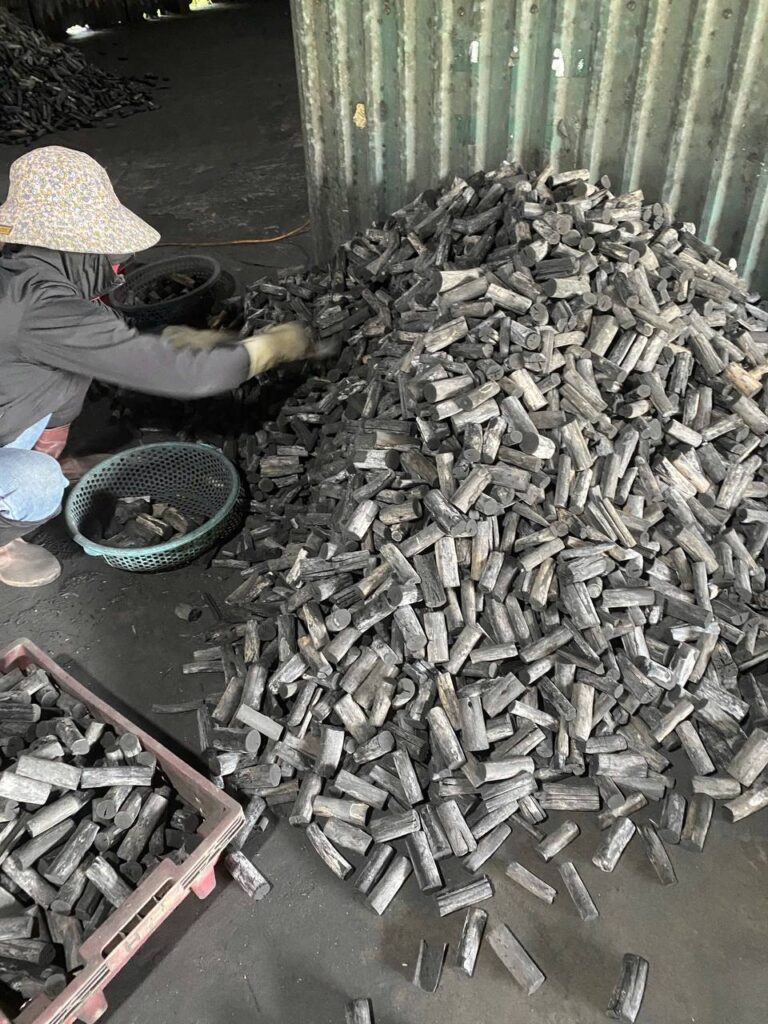
Made by carbonizing whole coconut shells, this type features naturally irregular shapes yet robust density. It’s famous for hot, steady heat, making it a favorite among BBQ enthusiasts who value quick ignition and long-lasting coals.
Coconut Charcoal Briquettes
Here, shells are ground, blended with natural binders, and pressed into uniform cubes or pillows. Why choose briquettes? They deliver consistent burn times, perfect sizing for shisha/hookah, and smokeless grilling. Restaurants worldwide trust Happy Viet’s briquettes for their reliability and cleanliness.
Specialty and Premium Blends
Some producers innovate with blends—mixing coconut shell with sawdust or bamboo charcoal to tailor properties for specific markets. These are popular for private label and bulk export, balancing price and performance for larger-scale buyers.
Production Process: Traditional vs. Modern Methods
- Collection and Sorting: Ripe coconut shells are gathered, cleaned, and sorted to remove impurities.
- Carbonization: Shells undergo low-oxygen heating in traditional clay pits or modern rotary kilns, transforming them into carbon-rich charcoal (at up to 600–800°C for shells, or over 1000°C for white/binchotan-like variants).
- Cooling and Quenching: Charcoal is cooled and sometimes sprayed with water to halt combustion.
- Crushing and Sieving: Shells are crushed, then sieved to achieve the preferred lump size or powder fineness.
- Briquetting (if applicable): Coconut shell powder is mixed with tapioca starch or similar binders and pressed into molds.
- Drying: The briquettes are slowly dried, often using solar or gas-fired ovens to reduce moisture below 8%.
- Packing: Packaged in moisture-proof, food-grade bags or boxes to maintain freshness for export.
Diagram suggestion: A stepwise flowchart showing from shell collection to final product packaging.
Modern factories deploy continuous kilns and advanced emission control, boosting efficiency by more than 30% and dramatically cutting pollution compared to open-pit burning. This not only ensures higher-quality charcoal but also supports sustainability goals.
Sustainability Practices in Charcoal Production
- Most reputable producers (including Happy Viet Charcoal) use only agricultural by-products—no trees felled for charcoal.
- Adoption of FSC™ (Forest Stewardship Council) standards guarantees traceable, legal sourcing of all raw shells.
- Investment in cleaner kilns, biofuel drying, and proper emissions handling minimizes the carbon footprint of every batch.
These responsible methods mean you’re not just grilling smarter—you’re supporting a greener planet.
Quality Standards & Certifications
- Carbon Content: High-grade coconut charcoal boasts 80–90% fixed carbon, guaranteeing hotter, longer-lasting fuel.
- Moisture Level: Should be below 8% for easy ignition and storage stability.
- Ash Content: International BBQ and shisha users prefer under 3%, ensuring minimal mess and better flavor purity.
- Burn Time: Premium Vietnamese coconut briquettes can burn for 2–3 hours in standard grills or hookah.
- Smoke and Odor: Food-grade, properly processed charcoal is virtually smokeless and neutral in scent.
| Certification | Scope | Benefit/Requirement |
|---|---|---|
| FSC™ | Sustainable raw material sourcing | Ensures eco-friendly, legal origins |
| ISO 9001/22000 | Production/process quality | Consistent manufacturing, food safety |
| Vinacontrol | Independent Vietnamese lab | Chemical, moisture, and residue tests |
| JIS | Japanese standards for imports | Additional tests for shisha and food use |
| CITES | For restricted woods (not coconut) | Regulates endangered species—usually not applicable to coconuts |
Astute buyers demand proof! Always ask for batch-specific certification copies—this is your assurance the coconut charcoal is truly food-safe and meets export thresholds.
Applications and Uses of Vietnamese Coconut Charcoal
- Domestic: Favored for home BBQs, grilling meat, and as a natural, non-toxic heating solution. Leaves less smoke indoors and less lingering smell on your food.
- Restaurants/Catering: Ensures a consistent heat source for busy kitchens, particularly in open-grill or smokehouse settings. Chefs love its flavor neutrality and extended burn time.
- Shisha/Hookah Lounges: The cleanest, longest-lasting embers—no unpleasant aftertaste or acrid smoke clouds.
- Industrial: Used in metallurgy (smelting), chemical filtration, air/water purifiers, soil enrichment (biochar), and even cosmetics (activated charcoal).
- Export Markets: Major buyers include Japan, Korea, Saudi Arabia, UAE, Germany, and the USA. Preference for Vietnamese coconut charcoal is attributed to its reliability, unique sustainability, and cost competitiveness.
For example, in 2024 alone, Japan imported over 30,000 metric tons of Vietnamese coconut charcoal, citing consistent shape and premium purity as deciding factors.
Vietnam’s Coconut Charcoal Export Market and Trends
- Export Volume: Vietnamese customs statistics show yearly coconut charcoal exports exceeding 200,000 tons, with an average annual growth above 12% (2023–2025).
- Top Destinations:
- Japan: especially for shisha and restaurant BBQ sectors.
- Korea: rapid chains and food franchises.
- Middle East: premium hookah coal markets in UAE, Saudi Arabia.
- USA/EU: growing eco-conscious consumer base for BBQ and home grilling.
- Competitive Advantages:
- Abundant coconut supply and mature production networks.
- Lower logistics costs due to Vietnam’s strategic seaports.
- Stringent quality controls, enabling large-scale, reliable export with private labeling (OEM) options.
- Trends: Surge in branded and retail-ready coconut charcoal products, with a pivot towards “green,” FSC™-certified, and food-safe claims to win environmentally conscious markets.
According to industry reports, coconut charcoal’s global market share is projected to hit $500 million by 2027, with Vietnam controlling a dominant slice.
Regulations and Export Procedures for Vietnamese Coconut Charcoal
- Export License: All shipments require government-issued export authorization for legal compliance.
- Phytosanitary Certificate: Proves the charcoal is pest- and disease-free—vital for US, EU, and Japan markets.
- Certificate of Origin (CO/O): Validates the Vietnamese origin of the product, important for trade benefits and customs clearance.
- Bill of Lading: The master shipping document, needed for port release and payment terms.
- Test/Analysis Reports: Moisture, ash, and safety testing reports from certified labs (e.g., Vinacontrol, SGS), which many buyers request by batch.
- Label and Packaging Standards: Must comply with importing country codes (e.g., FDA for the US, CE for Europe).
| Step | Description | Required Documents |
|---|---|---|
| Order Placement | Buyer places PO, negotiates specs and terms | Proforma Invoice, Product Specs |
| Production/Quality Inspection | Batches produced, sampled, tested | Factory test report, photos |
| Pre-Shipment Docs | All export, health certificates prepared | Export License, Phytosanitary, CO/O |
| Shipment & Handover | Goods loaded and shipped; buyer receives B/L and docs | Bill of Lading, Packing List |
| Customs Clearance | Buyer/importer clears product on arrival | All above, plus import permits as needed |
Tip: Reputable suppliers like Happy Viet Charcoal guide you step-by-step, ensuring hassle-free export experiences—no surprises!
Sourcing and Verifying Reliable Vietnam Charcoal Suppliers
- Clarify your application: BBQ, shisha, industrial, etc.
- Ask for detailed product specs (carbon content, moisture, size, ash, shape).
- Check for food-grade and FSC/ISO certifications—copies must be batch-specific.
- Demand recent lab test reports (moisture, ash, metals).
- Insist on a real company registration (no middlemen or untraceable email providers).
- Confirm the physical factory exists (request photos or a video call tour).
- Investigate references—ask for export records and real client contacts.
- Request batch samples and test them for odor, smoke, ash, and burn time.
- Review packaging quality—damp charcoal = wasted money.
- Always issue POs to a registered company account, not individuals.
- Clarify export documentation support (especially for tricky markets like the EU and USA).
- Pin down the lead time and flexibility for urgent shipment needs.
- Ask for warranty or after-sales service details.
- Confirm OEM/private label options—if you want to build your own brand.
- Evaluate logistics partners and cost transparency.
- Check for presence at trade shows (reputable exporters attend industry events).
- Inspect if third-party audits or inspections are allowed before shipment.
- Demand clear return/dispute policies—we all hope you never need them, but wise buyers plan ahead!
- Analyze website, online presence, and responsiveness. Poor English or slow reply = potential warning sign.
- Ask about production sustainability practices.
- Seek out photographic evidence of recent exports and product preparations.
- Confirm acceptance of secure payments (LC, TT to company, Escrow where possible).
- Be skeptical of very low prices—quality costs what it costs.
- Request detailed batch histories to avoid stockpiling or expired goods.
- Look for flexibility in minimum order quantities (MOQs), especially for new buyers.
- Ensure correct export packaging for your market (retail-ready, weatherproof, food-grade).
- Ask about access to downloadable tech sheets and freight calculators.
- Clarify whether product is compliant with all current international regulations.
- Insist on written agreements for every transaction, not just email promises.
- Stay vigilant for reviews and news coverage that could reveal scam reports.
- Test customer service—do they offer quick, knowledgeable assistance?
- Prefer established, branded exporters like Happy Viet Charcoal with years of experience and transparent policies.
Use this checklist as your safety net when sourcing Vietnamese coconut charcoal, whether for your backyard BBQ shop or a global trading house.
Frequently Asked Questions About Vietnamese Coconut Charcoal
- Is Vietnamese coconut charcoal food-grade and safe?
- Absolutely—when sourced from reputable suppliers, coconut charcoal is naturally clean, chemical-free, and safe for food contact, grilling, and shisha. Leading exporters provide batch-specific lab reports for peace of mind.
- How does coconut briquette charcoal differ from lump charcoal?
- Lump charcoal is made from whole shells, creating irregular shapes with high purity; briquettes are molded for uniformity and tailored burn properties—best for shisha and indoor grilling.
- Can I use coconut charcoal for indoor grilling?
- Yes, thanks to low smoke and odor, it’s a favorite in restaurants and homes—just ensure proper ventilation as with any charcoal.
- What documents do I need to import from Vietnam?
- Export license, phytosanitary certificate, certificate of origin, bill of lading, and lab analysis/test reports—these help ensure a smooth import process.
- How to check if my supplier is genuine?
- Ask for company registration, third-party references, photos of their facility, certifications—reputable firms never hesitate to provide full transparency.
Supplemental Content: Key Buyer/Importer Questions and Checklists
Boolean (Yes/No) Questions
- Is Vietnamese coconut charcoal food-grade? Yes—certified suppliers provide documentation to prove it.
- Can coconut charcoal be used indoors? Yes, provided adequate ventilation.
Comparative Questions
- Vietnamese vs. Indonesian coconut charcoal: Which is better for grilling?Vietnamese coconut charcoal delivers higher purity and lower ash due to advanced production controls. Many buyers prefer it for cleaner burning and more stable quality.
Grouping Questions
- Types grouped by burn performance: Lump = hotter, faster; Briquette = longer, more stable.
- Typical export markets: Lump charcoal for BBQ/restaurant chains, briquettes for hookah and retail packs.
Definitional Questions
- What is ‘binchotan’? A special high-temperature charcoal, usually from hardwood but sometimes produced from coconut, prized for exceptionally long burning and purity.
- What does FSC™ certification mean? Proof that materials are sourced ethically and sustainably, critical for eco-conscious buyers and import regulations.
Downloadables & Visual Content
- Export Documentation Checklist: Download PDF
- Infographics:
- Charcoal Types Comparison
- Production Process Flowchart
- Sustainability and Certification Pathways
These resources are designed to make your sourcing and importing journey as smooth as possible—be sure to check the links above!
Conclusion: Clean Fuel, Clear Conscience—Why Choose Happy Viet Coconut Charcoal?
Vietnamese coconut charcoal stands at the crossroads of tradition, innovation, and environmental stewardship. Whether you’re a restaurateur, distributor, or home grilling enthusiast, choosing sustainably produced, food-grade charcoal is a powerful step toward greener, tastier, and safer experiences.
At Happy Viet Charcoal, we offer proven quality, transparent certifications, fair pricing, and flexible export solutions. Our passion for clean energy and your success goes into every shipment. Looking for expert guidance or ready to place an order? Contact us today—let’s bring better, brighter, and greener grilling to every table!